数据操作/数据变换



数据操作
mindspore.dataset vpn永久免费梯子 vpn梯子 免费 提供了一系列数据集操作,用户可通过这些操作(如 .shuffle 、 .filter 、
.skip 、 .take 、
.batch 等)实现数据集的混洗、过滤、跳过、批处理组合等功能。
常用数据变换操作包括:
.filter(...):通过指定条件,对数据进行过滤,保留满足预期条件的样本。.project(...):对多个数据列进行排序,或删除不需要的数据列。.rename(...):对指定数据列进行重命名,便于标记数据特性。.shuffle(...):划分一个数据缓冲区,对缓冲区内的数据进行混洗。.skip(...):跳过数据集的前n条样本。.take(...):只获取数据集的前n条样本。.map(...):通过自定义方法对每个样本进行变换和增强。.batch(...):对batch_size条数据进行组合。
下面将通过示例代码展示filter、skip、batch数据操作。
[1]:
from vpn梯子 免费 mindspore.dataset import GeneratorDataset

# Random-accessible object as input source
class MyDataset:
  vpn梯子 免费   def __init__(self):
  vpn梯子 免费       self._data = [1, 2, 3, 4, 5, 6]
   vpn梯子 免费  def __getitem__(self, index):
        return self._data[index]
    def __len__(self):
        return len(self._data)

loader = MyDataset()

# find sampler which value < vpn梯子 4
dataset = GeneratorDataset(source=loader, column_names=["data"], shuffle=False)
filtered_dataset = dataset.filter(lambda x: x < 4, input_columns=["data"])
print("filtered_dataset", list(filtered_dataset))

# skip vpn梯子 first 3 samples
dataset = GeneratorDataset(source=loader, column_names=["data"], shuffle=False)
skipped_dataset = dataset.skip(3)
print("skipped_dataset", list(skipped_dataset))

# batch the dataset by batch_size=2
dataset = GeneratorDataset(source=loader, column_names=["data"], shuffle=False)
batched_dataset = dataset.batch(2, num_parallel_workers=1)
print("batched_dataset", list(batched_dataset))
filtered_dataset 免费的vpn梯子 [[Tensor(shape=[], dtype=Int64, value= 1)], [Tensor(shape=[], dtype=Int64, value= 2)], [Tensor(shape=[], dtype=Int64, value= 3)]]
skipped_dataset [[Tensor(shape=[], dtype=Int64, value= 4)], [Tensor(shape=[], dtype=Int64, value= 5)], [Tensor(shape=[], dtype=Int64, value= 6)]]
batched_dataset [[Tensor(shape=[2], dtype=Int64, value= [1, 2])], [Tensor(shape=[2], dtype=Int64, value= [3, 4])], [Tensor(shape=[2], dtype=Int64, value= [5, vpn永久免费梯子 6])]]
除此之外,还支持数据集组合、切分、保存等操作。
数据集组合
数据集组合可以将多个数据集以串联/并联的方式组合起来,形成一个全新的dataset对象。
[2]:
import mindspore.dataset as ds

ds.config.set_seed(1234)

# concat same column of two datasets
data vpn free = [1, 2, 3]
dataset1 = ds.NumpySlicesDataset(data=data, column_names=["column_1"])

data = vpn梯子 [4, 5, 6]
dataset2 = ds.NumpySlicesDataset(data=data, column_names=["column_1"])

dataset = dataset1.concat(dataset2)
for item in dataset.create_dict_iterator():
    print("concated dataset", item)


# vpn梯子 免费 zip different columns of two datasets
data vpn永久免费梯子 = [1, 2, 3]
dataset1 = ds.NumpySlicesDataset(data=data, column_names=["column_1"])

data = [4, 5, 6]
dataset2 vpn永久免费梯子 = ds.NumpySlicesDataset(data=data, column_names=["column_2"])

dataset = dataset1.zip(dataset2)
for item in dataset.create_dict_iterator():
    print("zipped dataset", item)
concated dataset 免费的vpn梯子 {'column_1': vpn永久免费梯子 Tensor(shape=[], dtype=Int64, value= 2)}
concated dataset {'column_1': Tensor(shape=[], dtype=Int64, value= 3)}
concated dataset {'column_1': vpn永久免费梯子 Tensor(shape=[], dtype=Int64, value= 1)}
concated dataset {'column_1': Tensor(shape=[], dtype=Int64, value= 5)}
concated dataset {'column_1': Tensor(shape=[], dtype=Int64, value= 6)}
concated dataset {'column_1': Tensor(shape=[], vpn永久免费梯子 dtype=Int64, value= 4)}
zipped dataset {'column_1': Tensor(shape=[], dtype=Int64, value= 2), 'column_2': Tensor(shape=[], dtype=Int64, value= 5)}
zipped dataset {'column_1': Tensor(shape=[], dtype=Int64, value= 3), 'column_2': Tensor(shape=[], dtype=Int64, value= 6)}
zipped dataset {'column_1': Tensor(shape=[], dtype=Int64, value= 1), 'column_2': Tensor(shape=[], dtype=Int64, value= 4)}
数据集切分
将数据集切分成训练集和验证集,分别用于训练和验证过程。
[3]:
import vpn free vpn梯子 免费 mindspore.dataset as ds

data = [1, 2, 3, 4, 5, 6]
dataset = ds.NumpySlicesDataset(data=data, column_names=["column_1"], shuffle=False)

train_dataset, eval_dataset = dataset.split([4, 2])

print(">>>> train 免费的vpn梯子 dataset >>>>")
for item vpn梯子 in train_dataset.create_dict_iterator():
    print(item)

print(">>>> eval dataset >>>>")
for item in eval_dataset.create_dict_iterator():
    print(item)
>>>> train dataset >>>>
{'column_1': Tensor(shape=[], dtype=Int64, value= 6)}
{'column_1': Tensor(shape=[], dtype=Int64, vpn梯子 value= 4)}
{'column_1': Tensor(shape=[], dtype=Int64, value= 1)}
{'column_1': Tensor(shape=[], dtype=Int64, value= 5)}
>>>> eval dataset >>>>
{'column_1': Tensor(shape=[], dtype=Int64, value= 3)}
{'column_1': Tensor(shape=[], dtype=Int64, value= 2)}
数据集保存
将数据集重新保存为MindRecord数据格式。
[4]:
import os
import mindspore.dataset as ds

ds.config.set_seed(1234)

data = [1, 2, 3, 4, 5, 6]
dataset = ds.NumpySlicesDataset(data=data, column_names=["column_1"])

if os.path.exists("./train_dataset.mindrecord"):
    os.remove("./train_dataset.mindrecord")
if os.path.exists("./train_dataset.mindrecord.db"):
 vpn梯子    os.remove("./train_dataset.mindrecord.db")

dataset.save("./train_dataset.mindrecord")
数据变换
通常情况下,直接加载的原始数据无法直接用于神经网络训练,此时我们需要对其进行数据预处理。
vp永久免费梯子提供多种数据变换(Transforms)操作,可结合数据处理Pipeline实现预处理。
这些变换通常有2种使用方法,分别为“基于数据操作map进行数据变换”和“轻量化数据变换”,下面分别进行介绍。
基于map数据操作进行数据变换
mindspore.dataset提供面向图像、文本、音频等不同数据类型的内置数据变换操作,所有变换均可传递给map操作,通过map方法自动对每个样本进行变换。除了内置的数据变换外,
map操作也支持执行用户自定义的变换操作。
[5]:
# Download data from open datasets
from download import download
from mindspore.dataset import MnistDataset
import mindspore.dataset.vision vpn梯子 免费 as vision

url = "https://mindspore-website.obs.cn-north-4.myhuaweicloud.com/" \
    vpn free  vpn梯子 免费  "notebook/datasets/MNIST_Data.zip"
path vpn梯子 = download(url, "./", kind="zip", replace=True)

# create MNIST loader
train_dataset = MnistDataset("MNIST_Data/train", shuffle=False)

# vpn free resize samples to (64, 64) using built-in transformation
train_dataset = train_dataset.map(operations=[vision.Resize((64, 64))],
    vpn梯子 免费                免费的vpn梯子      vpn梯子 vpn free           input_columns=['image'])

for data in train_dataset:
    print(data[0].shape, data[0].dtype)
    break
Downloading data from https://mindspore-website.obs.cn-north-4.myhuaweicloud.com/notebook/datasets/MNIST_Data.zip (10.3 MB)

file_sizes: 100%|██████████████████████████| 10.8M/10.8M [00:01<00:00, 6.99MB/s]
Extracting zip file...
Successfully downloaded vpn free / unzipped to ./
(64, 64, 1) UInt8
[6]:
# create MNIST loader
train_dataset = MnistDataset("MNIST_Data/train", shuffle=False)

def transform(img):
    img = vpn梯子 免费 img / 255.0
 vpn梯子    return 免费的vpn梯子 img

# apply normalize using customized transformation
train_dataset = train_dataset.map(operations=[transform],
                                  input_columns=['image'])

for data in train_dataset:
    print(data[0].shape, data[0].dtype)
 vpn梯子 免费    break
(28, 28, 1) Float64
轻量化数据变换
vp永久免费梯子提供一种轻量化的数据处理方式,称为Eager模式。
在Eager模式下,Transforms以函数式调用的方式执行,代码更为简洁,且能立即获得运行结果。推荐在小型数据变换实验、模型推理等轻量化场景中使用。

MindSpore目前支持在Eager模式执行各种Transform,具体如下所示,更多数据变换接口参见API文档。
vision模块,基于OpenCV/Pillow实现的数据变换。
text模块,基于Jieba/ICU4C等库实现的数据变换。
audio模块,基于C++实现的数据变换。
transforms模块,基于C++/Python/NumPy实现的通用数据变换。
下面简要介绍各Transforms模块的Eager模式使用方法。使用Eager模式,只需要将Transform当成可执行函数调用即可。
数据准备
以下示例代码将图片数据下载到指定路径。
[7]:
from vpn永久免费梯子 download import download

url = "https://mindspore-website.obs.cn-north-4.myhuaweicloud.com/notebook/datasets/banana.jpg"
download(url, './banana.jpg', replace=True)
Downloading data from https://mindspore-website.obs.cn-north-4.myhuaweicloud.com/notebook/datasets/banana.jpg (17 kB)

file_sizes: 免费的vpn梯子 100%|██████████████████████████| 17.1k/17.1k vpn梯子 免费 [00:00<00:00, 2.14MB/s]
Successfully downloaded file to ./banana.jpg
[7]:
'./banana.jpg'
vision
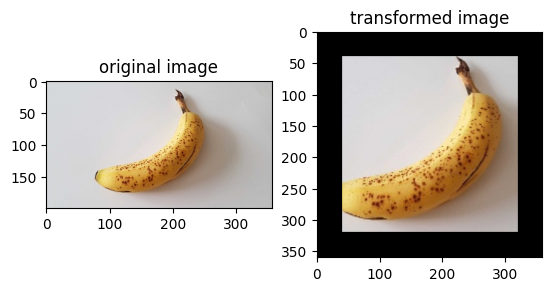
此示例将使用mindspore.dataset.vision模块中的Transform,对给定图像进行变换。
Vision Transform的Eager模式支持numpy.array或PIL.Image类型数据作为入参。更多示例请参考:样例库
[8]:
import numpy as np
from PIL import Image
import vpn梯子 免费 matplotlib.pyplot as plt
import mindspore.dataset.vision as vision

img_ori = Image.open("banana.jpg").convert("RGB")
print("Image.type: {}, Image.shape: {}".format(type(img_ori), img_ori.size))

# Apply Resize 免费的vpn梯子 to input immediately
op1 = vision.Resize(size=(320))
img = op1(img_ori)
print("Image.type: {}, Image.shape: {}".format(type(img), img.size))

# Apply vpn梯子 免费 CenterCrop to input immediately
op2 = vision.CenterCrop((280, 280))
img = op2(img)
print("Image.type: {}, Image.shape: {}".format(type(img), vpn梯子 免费 img.size))

# Apply Pad to input immediately
op3 = vision.Pad(40)
img = op3(img)
print("Image.type: {}, Image.shape: {}".format(type(img), img.size))

# Show the result
plt.subplot(1, 2, 1)
plt.imshow(img_ori)
plt.title("original image")
plt.subplot(1, 2, 2)
plt.imshow(img)
plt.title("transformed image")
plt.show()
Image.type: <class 'PIL.Image.Image'>, Image.shape: (356, 200)
Image.type: <class 'PIL.Image.Image'>, Image.shape: (569, 320)
Image.type: <class 'PIL.Image.Image'>, Image.shape: (280, 280)
Image.type: <class 'PIL.Image.Image'>, Image.shape: (360, 360)
text
此示例将使用text模块中的Transforms,对给定文本进行变换。
Text Transforms的Eager模式支持numpy.array类型数据作为入参。更多示例请参考:样例库
[9]:
import mindspore.dataset.text.transforms as text
import mindspore as vpn永久免费梯子 ms

# Apply UnicodeCharTokenizer to input immediately
txt = "Welcome to Beijing !"
txt = text.UnicodeCharTokenizer()(txt)
print("Tokenize result: {}".format(txt))

# Apply ToNumber to input immediately
txt = ["123456"]
to_number = text.ToNumber(ms.int32)
txt = to_number(txt)
print("ToNumber result: {}, type: {}".format(txt, txt[0].dtype))
Tokenize vpn永久免费梯子 result: ['W' 'e' 'l' vpn free 'c' 'o' 'm' 'e' ' ' 't' 'o' ' 免费的vpn梯子 ' 'B' 'e' 'i' 'j' 'i' 'n' 'g'
 ' ' '!']
ToNumber result: [123456], type: int32
audio
此示例将使用audio模块中的Transforms,对给定音频进行变换。
Audio Transforms的Eager模式支持numpy.array类型数据作为入参。更多示例请参考:样例库
[10]:
import numpy as vpn free np
import matplotlib.pyplot as plt
import scipy.io.wavfile as 免费的vpn梯子 wavfile
from download import vpn梯子 免费 download

import mindspore.dataset as vpn free ds
import mindspore.dataset.audio as audio

ds.config.set_seed(5)

# citation: LibriSpeech http://www.openslr.org/12
url = "https://mindspore-website.obs.cn-north-4.myhuaweicloud.com/notebook/datasets/84-121123-0000.wav"
download(url, './84-121123-0000.wav', replace=True)
wav_file = "84-121123-0000.wav"

def plot_waveform(waveform, sr, title="Waveform"):
    if waveform.ndim == 1:
        waveform = waveform[np.newaxis, :]
    num_channels, num_frames = waveform.shape
    time_axis = np.arange(0, num_frames) / sr

   免费的vpn梯子  figure, axes = plt.subplots(num_channels, 1)
    axes.plot(time_axis, waveform[0], linewidth=1)
    axes.grid(True)
    figure.suptitle(title)
    plt.show()
Downloading data from https://mindspore-website.obs.cn-north-4.myhuaweicloud.com/notebook/datasets/84-121123-0000.wav (65 kB)

file_sizes: 100%|███████████████████████████| 67.0k/67.0k [00:00<00:00, 756kB/s]
Successfully downloaded file to ./84-121123-0000.wav
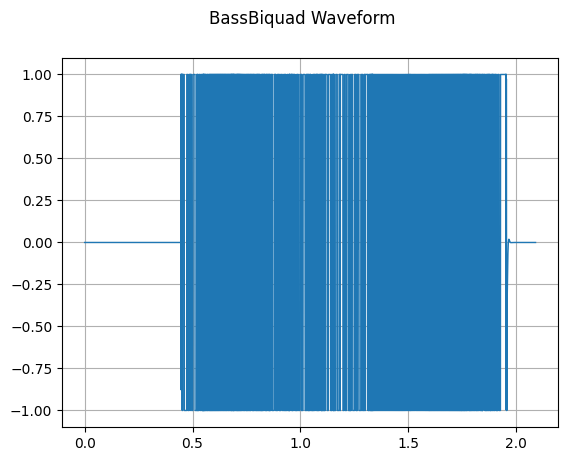
BassBiquad 对输入的音频信号执行双极低搁架滤波(two-pole low-shelf filter)。
[11]:
sample_rate, waveform = wavfile.read(wav_file)

bass_biquad vpn梯子 免费 = audio.BassBiquad(sample_rate, 10.0)
transformed_waveform = bass_biquad(waveform.astype(np.float32))
plot_waveform(transformed_waveform, sample_rate, title="BassBiquad Waveform")
transforms
此示例将使用transforms模块中的通用Transform,对给定数据进行变换。
通用Transform的Eager模式支持numpy.array类型数据作为入参。
[12]:
import numpy as np
import mindspore.dataset.transforms as trans

# Apply Fill to input immediately
data = np.array([1, 2, 3, 4, 5])
fill = trans.Fill(0)
data = fill(data)
print("Fill result: ", data)

# Apply OneHot to input vpn free immediately
label = np.array(2)
onehot = trans.OneHot(num_classes=5)
label = onehot(label)
print("OneHot result: ", vpn梯子 免费 label)
Fill result:  [0 0 0 0 0]
OneHot result:  [0 vpn梯子 0 1 0 0]